Trading the markets Technically

Saturday, July 08, 2006

Doji and Gap Combinations

Doji and Gap Combinations = Power Profits, Stocks & Commodities Magazine

The Doji is one of the most revealing signals in Candlestick trading. It clearly indicates that the bulls and the bears are at an equilibrium, a state of indecision. The Doji appearing at the end of an extended trend has significant implications. The trend may be ending. Just this fact alone creates a multitude of investment programs that produce inordinate profits. What is the best method for making big trading profits? Knowing the direction of a trading entity and the strength of that move. Candlestick analysis perfects that trading strategy. Candlestick formations reveal high probability profitable reversals. Hundreds of years of investing refinement has proven that point.

The Japanese say that whenever a Doji appears, always take notice. A well-founded rule of Candlestick followers is that when a Doji appears at the top of a trend, in an overbought area, sell immediately. Conversely, a Doji seen at the bottom of an extended downtrend requires buying signals the next day to confirm the reversal. Otherwise, the weight of the market could take the trend lower.

What could be better than knowing which way a market or a trading entity is going to move? One additional important element! How powerful is that new move going to be? A powerful indication that a strong trend is beginning is the appearance of a “window” or gap. Gaps (Ku) are called windows (Mado) in Japanese Candlestick analysis. A gap or window is one of the most misunderstood technical message. It is usually advised by a good percentage of investment advisors to not buy after a gap. This is very bad advice. The gaps will reveal powerful high profit trades. Candlestick signals, correlated with the appearance of a gap, provide valuable profit making set-ups.

The ramification of a gap pattern is an important aspect to Japanese Candlestick analysis. Some traders make a living trading strictly off of gaps. Dissecting the implications of a gap/window makes its appearance easy to understand. Once you understand why a gap occurs in different locations in a trend, taking advantage of what the gaps reveal becomes highly profitable. Where a gap occurs is important.

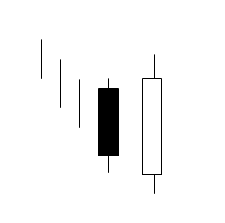
Consider what a window or gap represents. In a rising market, it illustrates prices opening higher than any of the previous day’s trading range. What does this mean in reality? During the non-market hours, something made owning this stock tremendously desirable. So desirable that the order imbalance opens the price well above the prior day’s body as well as the high of the previous day’s trading range (the same is true for a bearish indication, gapping down from the previous range). As seen in Figure 1, note the space between the high of the previous day and the low of the following day.

Figure 1 - Gap Formation.

Witnessing a gap or window at the beginning of a new trend produces profitable opportunities. Seeing the gap formed at the beginning of the trend reveals that on a reversal of direction, the buyers have stepped in with a great amount of zeal. A common scenario is witnessing a prolonged downtrend. A Doji appears, indicating that the selling may have stopped. To verify that the downtrend has stopped, indication of buying the next day is required. This can be more pronounced if the next day has a “gap” up move.

Many investors are apprehensive about buying a stock that has popped up from the previous day’s close. A risky situation! Yet a Candlestick investor has been forewarned that the trend is going to change, using a signal as that alert. A gap up illustrates that the force of buying in the new upward trend is going to be strong. The enthusiasm shown by the buyers trying to get into the stock demonstrates that the new trend should have a strong move to it. Use that gap as a strength indicator.

Doji and Gaps at the Bottom

Knowing that a gap represents an enthusiasm for getting into or out of a stock position creates the forewarning that a strong profit potential has occurred. Where is the best place to see rampant enthusiasm when you are buying? At that point you are buying, near the bottom. Obviously, seeing a potential Candlestick buy signal at the bottom of an extended downtrend is a great place to buy. In keeping with the concepts taught in Candlestick analysis, we want to be buying stocks that are already oversold to reduce the downside risk. What is even better is the evidence that buyers are very anxious to get into the stock.

Note in Figure 2, XMM, Cross Media Marketing, after Doji/Harami's, one on November 5th, another on December 18, 2001, that the gap up the next day clearly indicated that the trend had stopped. The resulting trades produced 28.5% and 49.3% respectively. Probabilities demonstrate that a gap up is going to preclude an advance in price under these circumstances. Unofficially, candlestick statistics illustrate an 80% and better probability that a trade will be successful when stochastics are oversold, a Candlestick “buy” signal appears, and prices gap up. (The Candlestick Trading Forum provides candlestick statistics that they represent as “unofficial.” Even though over fifteen years of observations and studies have been involved, no formal data gathering programs have been fully operated. However, currently the Candlestick Trading Forum is involved with two university studies to quantify signal results).

Figure 2, XMM, Cross Media Marketing

Having this statistic as part of an investor’s arsenal of knowledge creates opportunities to extract large gains out of the markets. The risk factor remains extremely low when participating in these trade set-ups.

Many investors are afraid to buy after a gap up. The rationale being that they don’t like paying up for a stock that may have already moved 3%, 5%, 10% already that day. But this rationale is unimportant to the Candlestick investor. Witnessing a Candlestick “buy” signal prior to the gap up provides a basis for aggressively buying the stock. If it is at the bottom of a trend, that 3%, 5%, 10% initial move may just be the beginning of a 25%, 30%, 40% move or a major trend that can last for months.

Doji and Gaps at the Top

Gaps and windows reveal a strong force in a direction whether it is bullish or bearish. The Candlestick signal is the prime factor for looking for a reversal. A gap down after a “sell” signal verifies that the signal was effective. The Japanese say that a Doji at the top of a sustained trend warrants immediate liquidation. That becomes more evident if the prices gap down the next day. Note in Figure 3, ISSI, Integrated Silicon Solutions, the Doji at the top, with stochastics in the overbought area, would have been the warning. If investors were long, upon seeing the Doji, they should liquidate at the first sign of a weaker open. The gap down the next day would have been more than enough to convince the Candlestick investor that the sellers had stepped in.

Figure 3, ISSI, Integrated Silicon Solutions

The investor that does not utilize the information revealed by gaps/windows is leaving massive profits for somebody else. Just as the Candlestick signals have different meanings at different points in a trend, the gaps have different messages at certain points in a trend. The Candlestick signals, signals that have imbedded information in their formation, combined with a gap/window, also a signal that implies a magnitude of buying or selling interest, creates one of the most powerful investment tools found in technical analysis. The major function of technical analysis is to find trade patterns that put probabilities highly in our favor. Hundreds of years of profitable observations have identified the Doji as a prime reversal signal. Gaps have demonstrated many times over that they are the driving force of a trend direction. The combination of these two indicators produce profits that cannot be ignored.

CANDLESTICKS WITH GAPS

Technical Analysis Chart Formations - Combining Candlestick Signals and Gaps

Technical analysis chart formations provide high profit return potential when using Candlestick signals. Candlestick analysis involves the visual identification of patterns that have been recognized for hundreds the years. Identifying technical analysis chart formations that have produced a statistical probability result makes for an excellent trading format.

One of the most powerful technical analysis chart formations is the gap. Gaps occurring at different locations in a trend have different meanings. Taking advantage of what gap analysis reveals becomes highly profitable. Dissecting the implications of a gap/window makes its appearance easy to understand. Where a gap occurs is important. The ramification they reveal in a chart pattern is an important aspect to Japanese Candlestick analysis. Some traders make a living trading strictly from gap trading.

Gaps (Ku) are called windows (Mado) in Japanese Candlestick analysis. A gap or window is one of the most misunderstood technical messages. It is usually advised by a good percentage of investment advisors to not buy after a gap. The explanation being that it is too dangerous to predict what will happen next. That advice usually comes from somebody that does not know how to use gaps successfully. Gaps reveal powerful high profit trades. Candlestick signals, correlated with the appearance of a gap, provide high-probability profitable trade set-ups. The unique built-in forces, encompassed in the Candlestick signals, and the strength of a move revealed by the existence of a gap, produce powerful trading factors. The knowledge of what this combination of signals reveal will produce consistent and strong profits.

These technical analysis chart formations are not “hidden” secret signals or newly discovered formulas that are just now being exposed to the investment world. These are a combination of widely known but little used investment techniques. Candlestick signals obviously have a statistical basis to them or they would not still be in existence after many centuries. Gaps have very powerful implications. Combining the information of these two elements produces investment strategies that very few investors take the time to exploit.

Consider what a window or gap represents. In a rising market, it illustrates prices opening higher than any of the previous days trading range. What does this mean in reality? During the non-market hours, something made owning a stock, or any other trading entity, tremendously desirable. So desirable that the order imbalance opens the price well above the prior day's body as well as the high of the previous day's trading range. As seen in Figure 1, note the space between the high of the previous day and the low of the following day.

Witnessing a gap or window at the beginning of a new trend produces profitable opportunities. Gaps formed at the beginning of the trend reveal that upon the reversal of direction, the buyers have stepped in with a great amount of zeal. A common scenario is witnessing a prolonged downtrend. A Candlestick signal appears; a Doji, Harami, Hammer, or any other signal that would indicate that the investor sentiment is changing. What is required to verify a Candlestick reversal signal at the bottom? More buying the next day! A bullish candle indicates a reversal has occurred. A “gap-up” bullish candle indicates that a reversal has occurred with extraordinary force.

Many investors are apprehensive about buying a stock that has popped up from the previous day's close. A risky situation! The hesitancy is caused by the percentage move. When most investors are happy with a 10% return annually, it is hard for an investor to commit funds to a position that has moved 12% in one day. Understanding what the gap-up represents eliminates that fear.

A Candlestick investor has been forewarned that the trend is going to change, viewing the Candlestick signal as the alert. A gap-up, illustrating buyer enthusiasm, reveals excessive strength. Use the gap as a strength indicator. The fact that the initial move is substantial should act as an indication that the remaining move of this new trend could be more substantial.

Always keep in mind, the markets do not care what investors fears and perceptions are. A price that has moved dramatically in one day may be cause for fear to enter a trade from most investors. They do not have the knowledge to understand what that strong move illustrates for the future.

Gaps form in many different places and forms. Some are easy to see, some need to be recognized. Utilizing the technical analysis chart formation information provides the capability to be involved with high profit trades. The information provided from the combination of a Candlestick buy signal or sell signal, followed by a gap, reveals an immense amount of information. And being able to analyze the technical analysis chart formation correctly provides an investor with the opportunity to make good consistent profits.

ENGULFING PATTERNS

Candlestick Engulfing Patterns - Neon Signs to Buy and Sell, Stocks & Commodities Magazine

The most striking facet of Japanese candlesticks is their ease of identification. Hundreds of years ago, Japanese rice traders become ultra-wealthy using Candlestick signals to trade rice. These signals were developed through simple observation. As years of successful utilization of the signals progressed, they even were able to analyze the psychology behind forming the signals. This provided a very powerful tool for projecting future price movement.

Two of the most compelling candlestick signals are the Bullish Engulfing Pattern and Bearish Engulfing Pattern. They are most effective when founding the oversold area, at the end of a substantial downtrend or the overbought area for the Bearish pattern. The Bullish Engulfing pattern consists of two bodies. The first body is the same color as the current trend, the second is the opposite color. The signal day opens lower than the previous days close, then it trades higher so by the end of the day, it will close above the previous days open. This new white candle now engulfs the previous days candle, known as the DAKI, or the embracing line.

Figure 1 - Bullish Engulfing

Witnessing a white bullish candle, engulfing the previous black candle, stands out like a neon sign after a series of black candles. It becomes very plain to see that a change has occurred in investor sentiment. A couple of simple factors make the Bullish Engulfing pattern more convincing. The bigger the previous days candle being engulfed, the more effective the new trend signal will be. Or the lower the open of the white candle, then coming back up to engulf the previous day, the more powerful the next advance should be.

The formula is relatively simple;

(O1>C1) and (O O1). Defined as the open of yesterday is greater than the close of yesterday. And the open today is less than the close of yesterday, And the close of today is greater than the open of yesterday.

The Bullish Engulfing pattern represents a complete change in investor sentiment. Using this pattern as a buy signal eliminates the need to grab for the fallen knife. When is “low” the right time to buy? The Bullish Engulfing pattern reveals when the buyers have stepped in. Note in the Dow Jones industrial chart that the whole market sentiment reversed at the Bullish Engulfing formations. The signals work equally well when analyzing indexes as they do for individual stocks, commodities, futures or any other trading entity.

Having the knowledge of just eight or nine Candlestick signals, the Bullish and Bearish Engulfing patterns being on that list, produces huge advantages for analyzing the direction of the markets in general. This reinforces the analysis of an individual stock price.

Training Video for Engulfing Patterns

Figure 2 - Dow Jones Industrials

The Bearish Engulfing pattern is the exact opposite that of the Bullish Engulfing pattern. After an obvious uptrend, the bulls finally gap it open due to there exuberance to get in the position. If stochastics are showing that this is occurring in the overbought area, the candlestick investor becomes very diligent. A gap, however slight, away from the previous days close, should alert the candlestick investor that the trend may be ending. If long, putting a stop one half way down the last bullish candle is usually prudent. If trading comes back through that point and closes below the open of the previous day, a bearish engulfing pattern has formed. Now you can short the stock with confidence. If nothing more than being long, you now know to close the position. Knowing the direction of the market allows the investor to establish positions with more confidence. Knowing that the market indexes have turned positive permits an investor to commit funds to the long side with more aggression than normal. As seen in the above DOW chart, being able to visualize the Bullish Engulfing patterns after extensive downtrend would have allowed an investor to get in and make impressive profits.

As in the Bullish Engulfing pattern, the Bearish Engulfing pattern is very easy to see. It stands out as a blatant change of direction in the trend. The white bodies in the uptrend now have a large black candle stopping the trend.

Figure 3 - Bearish Engulfing

The black candle acts as an obvious sign against the uptrend. The formula is exactly opposite of the Bullish Engulfing pattern formula. ( C1 >O1) and the(O>C1) and (C>O1), The close of the first day is higher than the open, thus a white candle. The next day has an open than is higher than the previous day’s close and closes lower than the previous days open.

The visual depiction of a Bearish Engulfing pattern creates an ominous darkness at the top of a trend. It does not take learning complicated formulas or analyzing numerous indicators to understand a candlestick signal.

Figure 4 - Enzon Inc

Note how the Bearish engulfing pattern terminates the uptrend in the Enzon Inc. chart.. As the trend persists, buyers finally get so exuberant, they gap the price up. It immediately starts losing ground until it finally closes lower than where it opened the previous day. This clearly illustrates that the sellers have gained strength. That confirmation of selling starts a trend of selling.

The Engulfing patterns are statistically valid for indicating reversals at the tops and the bottoms. As stated early, the signals are highly accurate when a bullish Engulfing pattern is witnessed during oversold conditions. Conversely, the Bearish Engulfing pattern is valid in the overbought area. But both have a recognized indicator at the other end of a trend. A big bullish Engulfing pattern observed at the top of a trend usually represents the last gasp of the trend. The same occurs at the bottom of a trend with the Bearish Engulfing pattern. The last gasp sellers create a bearish engulfing pattern which usually is followed by increased buying. Remembering this fact provides another opportunity to extract profits out of a price trend. When the “hopeful” are buying once more at the top or the “panicked” are selling their last stock position at the bottom, the Candlestick investor is already familiar with what that last bullish or bearish engulfing pattern indicates at the wrong end of a trend. Putting on positions becomes a comfortable endeavor while everybody else is buying or selling the wrong way.

The Candlestick Engulfing patterns have survived centuries of investment skepticism. The Japanese Rice traders become ultra-wealthy utilizing these patterns. This is not rocket science. Rice traders developed high profit trading programs using purely visual recognition of reoccurring high probability formations. This is the most convincing form of statistical analysis. Use it to your advantage.

How Stock Market Price Rises and Falls

How Stock Market Price Rises and Falls

By: Ken Charnly

Understanding how stock market price rises and falls is similar to understanding the prices of other products in the market. It also follows the law of supply and demand. Price of stocks rise and fall due to the following reasons:

1. Company profit projections and image

A company’s growth and profit forecasts describe how capable a company is in delivering its promises to its investors. These numerical projections are carefully prepared by a company based on their past profits and projected additional profits due to new products and services, operations and infrastructure improvement.

Aside from profit forecasts, company image can also make an impact on a company’s profitability. Rumors of change in management, take-over, mergers, and even personal issues about the company’s top executives can affect the company’s image.

For example, a rumor of a merger between two big companies projects more stability and greater profit projections for both companies. As more investors would want to buy stocks from these merging companies, the demand for their stocks will rise. Based on the law of supply and demand: the greater the demand for stocks, the higher will their prices be.

A bankruptcy rumor about a company can send its investors to sell all their stocks. If there are more sellers than buyers of stocks then the supply (of stocks) is greater than the demand for stocks thus, stock price will fall.

2. Political Economy

General news about the local and global politics has an immediate impact on the economy and consequently to stock market prices. Politics and economics are correlated. Positive news such as lower unemployment rates, increased productivity, peace and order, and strong confidence in the government has positive impact on the economy. Such news encourages more local and international investors to open companies in a certain location or country. This in turn would generate more jobs, and as an effect, would encourage more trading in the market at higher stock prices in general due to the increase in demand for stocks of different companies.

On the other hand, negative news such as political instability and turmoil, security problems such as terrorism and insurgency, frequent strikes, and inflation has negative impact on the stock market prices. Investors are driven away by these things and close-up. As an effect, more stockholders would sell out. This creates more sellers than buyers thus stock market prices fall.

3. Interest rates

Higher interest rates are associated with a slump in economic growth. This creates a sluggish environment where investors become apprehensive in buying stocks. Either they keep the status quo or sell out their stocks. When the demand for stocks is not high, prices will go down.

Monday, July 03, 2006

NIFTY 1 MINUTE CHART IHS

Nifty cash formed an inverted Head & Shoulder pattern around 12:27 PM today. This formation was on 1 Minute chart. The target was 3132.50, which was acheived in 8 minutes flat. Actual High reached was 3133.75. Please see the attached chart. The main stock which pulled the Nifty up was Reliance: see the attached chart.

Sunday, July 02, 2006

TATA MOTORS

TATA MOTORS has retraced exactly at 0.618 levels on the weekly charts, see the chart attached. Is it making an Inverted Head & Shoulder pattern, where the target comes to around RS 945/-

RPS for the date 02/07/2006

Presently, nothing is outperforming the general Market right now. Relative Price Strength, has been calculated, considering the SENSEX as the base.
Security Name CLOSE RANK Ticker Symbol
Marathon Nextgen Realty & Text 364.8 62.5476 503101
ANIL MODI(P) 10.73 53.9626 519003
CRESSANDA SO 45.05 46.8259 512379
Transpek Fin.Ltd 7.65 45.9414 531254
OSCAR GLOBAL 9.12 44.4837 530173
SAN ENGG. 82.35 41.6974 505155
Suryanagri Fin 13.12 39.9 530867
Harvic Mgt.Servi 0.76 39.6046 511613
Shyam Software 2.54 39.1411 531598
Bholanath Intern 10.25 37.569 530841
Asian I Network 3.15 35.9226 519485
SATELITE ENGG 4.96 35.8169 522279
BIRLA TRANS. 76.75 35.4922 503823
TIRUP FOAM 44 30.8195 590035
TRIUMPH INT 4.84 29.4148 532131
Unitech Ltd 226.95 27.2054 507878
Baid Leasing 6.61 27.1171 511724
Poonam Corpn 7.43 27.0414 531219
Kay Pulp & Pape 3.65 26.1006 530255
IOLBROADBAND 76.65 25.6671 512185
Sunil Agro Foods 20.95 25.6395 530953
Omega Interactive 5.2 25.613 511644
Mangalya Sof 6.77 25.3189 530243